
Steal Like an Artist Summary: Why Originality Is a Myth
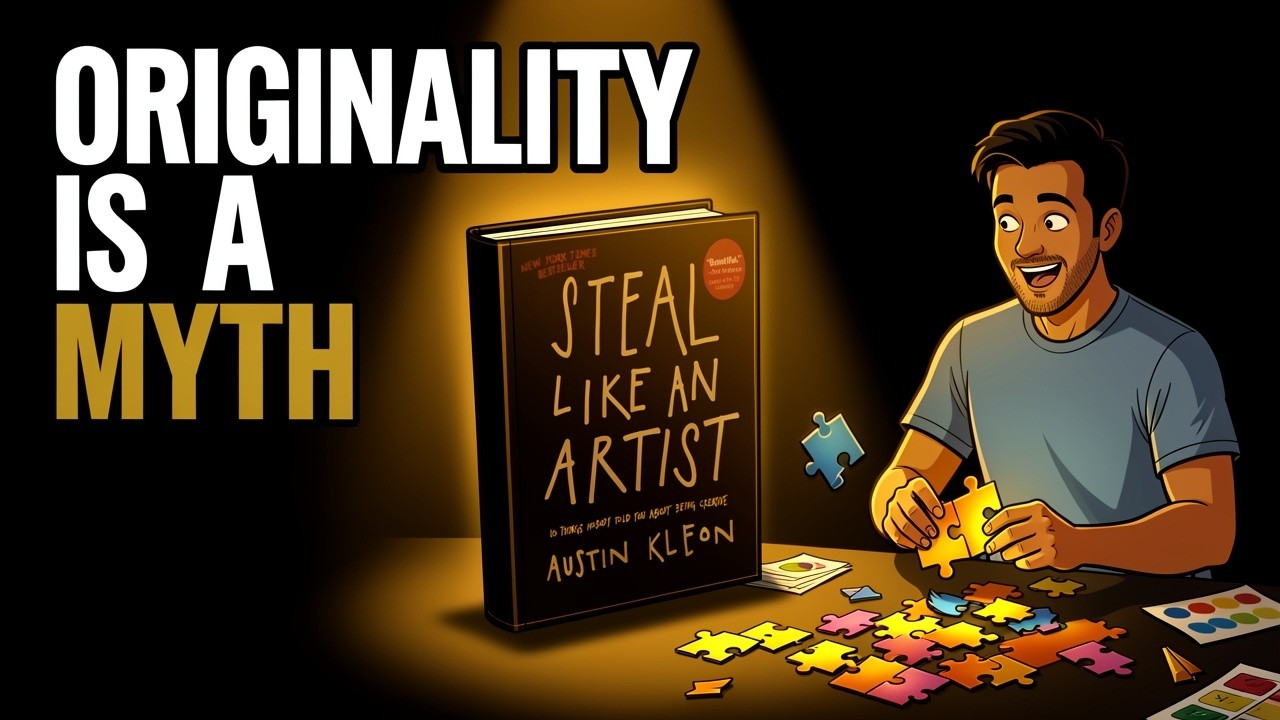
Prefer to watch? Open the animated summary on YouTube.
In one lineNo idea is fully new, so study the work you admire, remix it with your own life, and start making things before you feel ready.
Key lessons
- Every idea builds on earlier ideas. Being influenced is normal, not shameful.
- You find your own voice by imitating others and failing to copy them exactly.
- Study one hero deeply, then the people who inspired that hero.
- Keep your day job if it pays the bills and leaves you some energy.
- Use your hands, not only a screen, so ideas have room to grow.
- Share your work early. Being unknown is a time of freedom.
- Limits, such as little money or time, can sharpen your style.
On this page (8 sections)
You have an idea that feels fresh. Then you search online and find someone already built a version of it, maybe years ago. You feel like a fraud. It seems everything worth making has been made.
Steal Like an Artist by Austin Kleon says this feeling is not just wrong. It can stop you from doing the work you are meant to do. The book argues that no idea is truly original, and that this is good news.
What is Steal Like an Artist about?
Austin Kleon is an American writer and artist. He published the book in 2012. It is short and easy to read, and it began as a talk he gave to young creative people.
His central claim is that every idea is a remix of earlier ideas. Kleon does not mean plagiarism. He does not say to copy someone’s work and sign your name. He says every creator builds on the work of others. The real question is whether you do it on purpose and with skill.
He gives examples. The Beatles loved the music of Chuck Berry before they became famous. Steve Jobs studied calligraphy, and it later shaped the look of Apple’s computers. Breakthroughs usually come from influences that a person absorbed and changed.
You find yourself by imitating
Kleon describes his own start. He tried to write exactly like the writers he admired. He copied their sentences and rhythms. The results were poor, because he was trying to be them.
But his copies were never perfect. His own voice leaked through the gaps. He could not become someone else, so he found his style in the differences. The failure was the discovery.
So do not wait to know who you are. Start with the work, and your identity will follow. A young designer in Delhi who copies the layouts she loves will slowly notice her own choices appearing.
Build a family tree of influence
Kleon gives a simple method. Pick one person whose work excites you. Study them deeply. Read what they wrote, watch their interviews, and learn who inspired them. Then study those people too.
You will find that your hero is not alone. They sit in a network of influences. When you see where they came from, you can see where you might go. Your originality lives in the unique mix of influences you choose.
He also suggests a steal file, which is one folder for quotes, images, songs and designs that excite you. When you sit down to create, you start from a pantry, not from nothing.
Keep your day job, use your hands, share early
Kleon says to keep your day job. A job that pays the bills and does not drain all your energy gives you stability. Your art then does not have to pay the rent. He notes that T. S. Eliot worked at a bank, and William Faulkner worked at a power plant.
He also urges you to use your hands. On a screen, you can delete a rough idea at once. With paper, paint or clay, the process is messier and ideas have time to grow. A workspace full of books and notebooks helps more than a bare desk.
Finally, share before you are ready. Waiting for perfect work means waiting for ever. Being unknown is a gift, because nobody expects anything from you yet. You can try, fail and find your voice in public.
Three hard truths
First, waiting for inspiration is a trap. Creativity is a practice, not a mood. You show up and do the work, and inspiration often follows.
Second, limits can help. When you have every resource, you face too many choices. When you have few, you must invent. No studio? Work at your kitchen table. The limit can become your style.
Third, your life is your biggest creative work. If you neglect sleep, health and relationships, your output suffers. A burned-out artist makes little.
Credit and remix
Kleon is careful to separate learning from stealing. He says to copy the thinking behind a work, not only its surface. Take what you admire, ask why it works, and change it with your own view. Then give credit to the people who taught you.
A marketer in Bengaluru might admire a famous campaign. Copying the same slogan would be plagiarism. Studying why it worked, then using that lesson for a local product, is the kind of remix Kleon means. The result carries her own experience, and that is where the original part comes from.
How to use this at work and at home
- Pick one person you admire and learn all you can about them this week. Then study one of their influences.
- Start a steal file in a folder or notebook. Add anything that makes your mind light up.
- Make something rough today. Write a paragraph, sketch a slide or post one idea.
- Change your setting for a day. Work from a new room or walk through a museum.
- Do not wait for permission, a title or a degree. Start with what you have.
Our take
The strongest part of the book is the permission it gives. Many people hold back because they fear being copycats. Kleon replaces that fear with a method: study, remix, share. It is short, practical and encouraging.
There are limits. The line between learning from someone and taking their work is real, and Kleon spends only a little time on it. A reader should credit sources and never pass off another person’s work as their own. The advice to keep a day job also assumes a stable job, which not everyone has. And the book gives ideas, not a full plan, so you must build your own routine.
If you treat it as a mindset shift, it is useful and quick to try.
The animated summary shows each idea with stories. It takes about 10 minutes.
Who should read Steal Like an Artist?
Writers, designers, marketers and anyone who feels stuck because they think their ideas are not new enough.
Watch the full animated summary
Every idea from Steal Like an Artist, told as a story in about 11 minutes.
As an Amazon Associate, we earn from qualifying purchases.