Think Again Summary: The Power of Knowing What You Don't Know
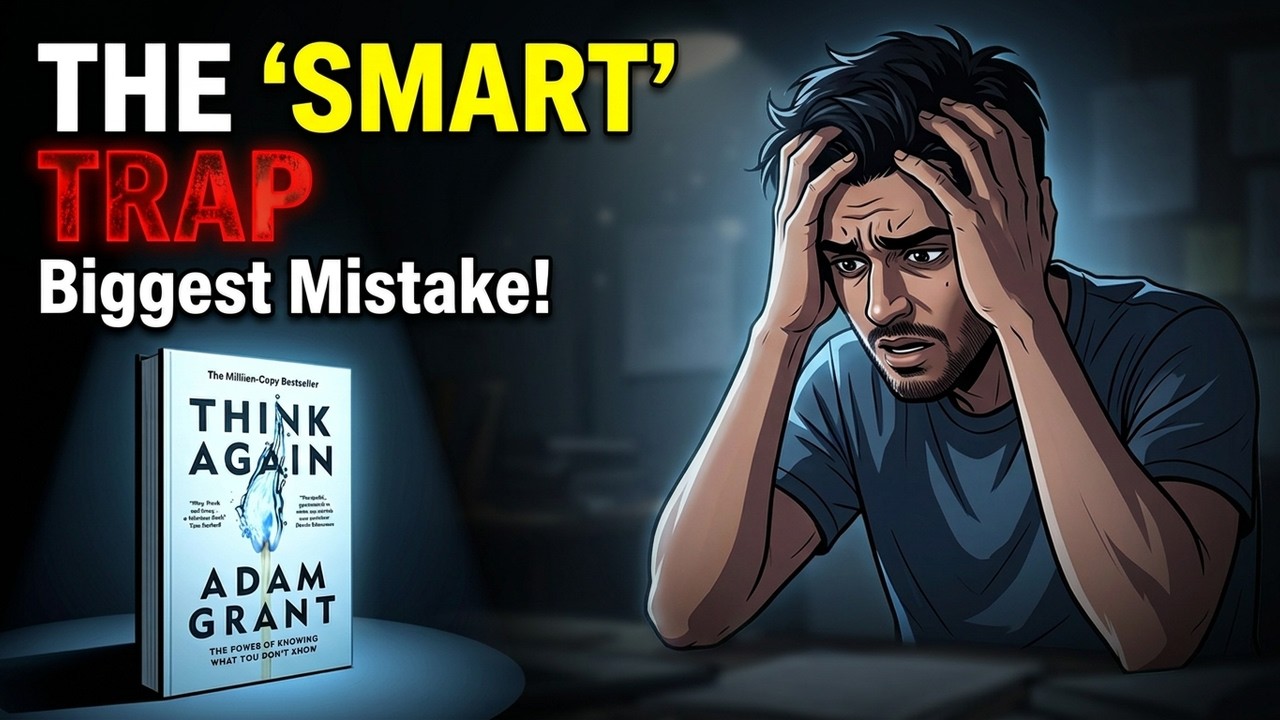
Prefer to watch? Open the animated summary on YouTube.
In one lineBeing able to change your mind matters more than what you already know, so treat your opinions as ideas to test, not as things to defend.
Key lessons
- Feeling certain is not proof. Expertise can make you check less and doubt less.
- Under challenge, people act like a preacher, a prosecutor or a politician. None of them tests the idea.
- Think like a scientist: turn a belief into a hypothesis and look for evidence against it.
- Anchor your identity in values, not in opinions, so you can change a view without losing yourself.
- Confident humility means trusting your ability to learn while doubting what you know today.
- To change a mind, show interest, bring fewer arguments, ask real questions and be honest about doubt.
- Review your career path twice a year, like any other hypothesis.
On this page (9 sections)
Somewhere in your head is an opinion that is wrong. It might be about your job, your money or a person you trust. The hard part is that a wrong opinion feels exactly like a right one. It has the same confidence and the same calm.
Think Again by Adam Grant is about this problem. His answer is a skill: the ability to doubt your own view, test it and change it when the evidence changes.
What is Think Again about?
Adam Grant is an organizational psychologist who studies how people work and think. He published Think Again in 2021. His main claim goes against what school teaches. Knowing a lot is useful. But in a world that keeps changing, the ability to rethink is worth more.
Old knowledge feels safe, yet it can be wrong. Your phone gets updates every month. Many of your core beliefs have not been updated in years.
Why smart people get stuck
Grant says expertise can make your thinking worse. The more you know about a topic, the less you feel you need to check. The expert stops asking the questions that made him an expert.
He describes a loop. You form a firm view. The view filters what you notice. Evidence that agrees gets through, and evidence that disagrees bounces off. This strengthens the view. The loop runs strongest where you feel most qualified.
You can hear it in a meeting. “I have seen this before.” “We tried that years ago.” “Trust me.” Sometimes these lines carry real wisdom. But they all end the discussion instead of starting it.
The three masks we wear in an argument
When someone challenges a belief, most people act like one of three characters.
- The preacher defends sacred ground and repeats the point louder.
- The prosecutor attacks the other side’s logic and tries to win.
- The politician stops caring about the truth and tries to win votes.
In all three, the real question has vanished: is my belief true? Nobody is testing it. These masks appear because we tie beliefs to identity. A challenge to the opinion feels like an attack on us.
Notice your own favourite. Some people preach in meetings, some prosecute in online comments, and some politick in the corridor.
Think like a scientist
The alternative is to treat an opinion as a scientist treats a hypothesis. It is a claim to test, not property to guard. Grant gives three moves:
- Rewrite the belief as a hypothesis. Instead of “remote work does not suit our team”, say “I predict our team does worse when remote”. Evidence can settle that sentence.
- Look for evidence against it. Your mind already collects support. Your job is the opposite search.
- Let the conclusion move. If the evidence changed and your view did not, you are guarding, not thinking.
Hold values firmly, hold opinions loosely
Imagine a teacher who has set homework for twenty years. New research suggests homework helps little. If her identity is “homework works”, she feels attacked and fights back. If her identity is “I find what helps students learn”, the same research is help. She can change her method and still be herself.
This is the key step. Anchor your identity in values, such as honesty and curiosity. Let your methods and conclusions stay open to change.
Grant also warns against doubting everything. His balance is confident humility. You trust that you can learn and adapt. You stay humble about whether today’s knowledge is right. A manager who says “here is my current view, here is what I am least sure about, and here is what would change my mind” is usually trusted more, not less.
How to disagree without making an enemy
Arguing with many points at once often makes the other person dig in. Being beaten in public does not change minds. Grant suggests four habits:
- Show real interest in their view.
- Bring fewer arguments, only your strongest two or three.
- Ask honest questions. People believe conclusions they reach themselves.
- Share your own doubt, such as “I am torn on this part”.
The shift is from “I want to win” to “I want to find out”. That is the version that moves people.
Teams that can rethink
Many companies keep doing things that no longer work. Often it is because being wrong feels unsafe. People stop speaking up. Grant calls the fix psychological safety. It is a culture where people can raise a problem or admit a mistake without fear. It starts at the top, with leaders who share their own errors.
Another simple step is to share your process, not just your conclusion. Say what you assumed and what would change your mind. A line such as “what evidence would make us reverse this decision?” is worth adding to any proposal.
How to use this at work and at home
- Pick one opinion you hold with total confidence. Say it as “this is a hypothesis I have not tested lately”.
- Explain that opinion out loud to someone. Note where you become vague or irritated. That is where your knowledge runs out.
- Search for the strongest argument against your view. Write it so its supporters would agree with it.
- In your next disagreement, ask two real questions before you give any argument.
- Add “what would change our mind?” to your next proposal or project review.
- Twice a year, spend fifteen minutes asking whether your career still fits you. Ask what has changed, whether your goals moved, and whether you are still learning.
Our take
The best part of Think Again is how practical it is. The hypothesis habit and the career check are easy to try. The three masks are also a good tool to spot in yourself, not just in others.
There are limits. Many ideas, such as confirmation bias, were known before. The book can read as a list of stories, and some of them are told in a tidy way. It also says little about situations where you cannot rethink freely, such as a boss who punishes any doubt. And rethinking has a cost. You cannot test every belief, so choose the ones that matter most.
Still, it is a useful reminder that changing your mind can be a sign of strength.
The animated summary walks through each idea with stories. It takes about 18 minutes.
Who should read Think Again?
Professionals, managers and team leads who want to make better decisions, disagree without conflict, and avoid being stuck in old ideas.
Watch the full animated summary
Every idea from Think Again, told as a story in about 18 minutes.
As an Amazon Associate, we earn from qualifying purchases.