
Don't Believe Everything You Think Summary: Stop Overthinking
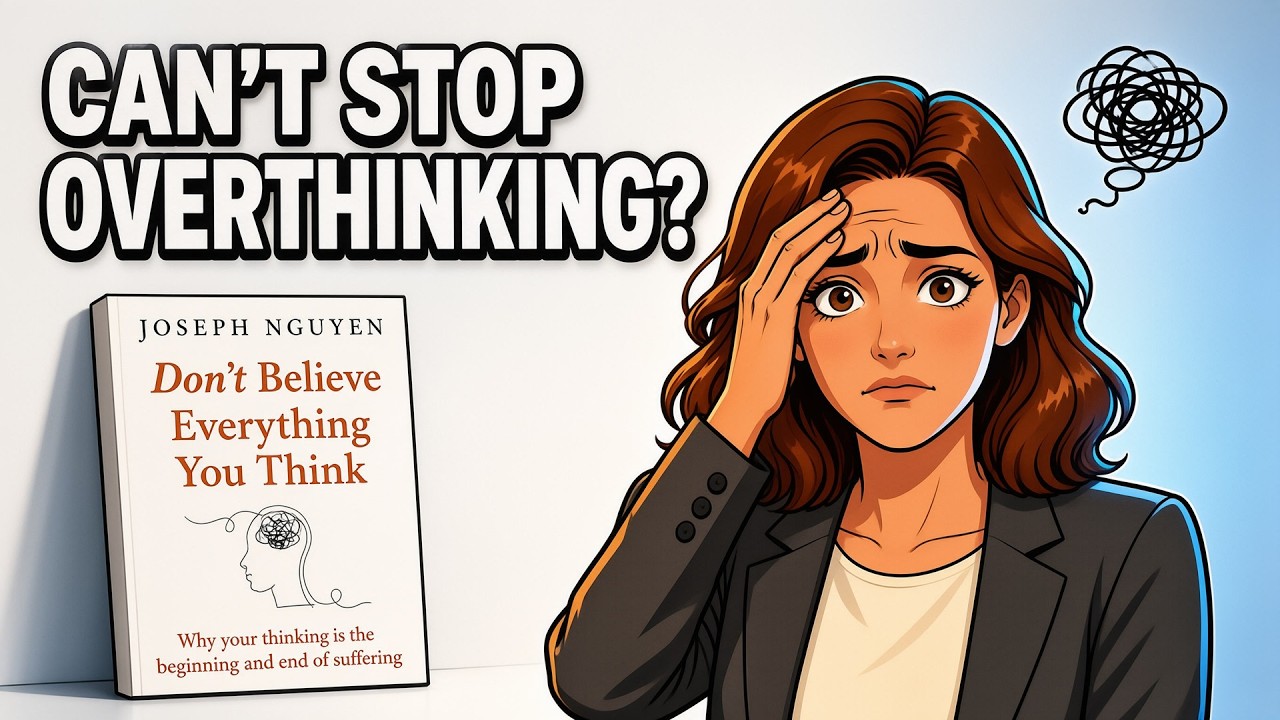
Prefer to watch? Open the animated summary on YouTube.
In one lineYour thoughts are not the problem. Your thinking about them is, and when you notice it and stop fighting it, it starts to pass.
Key lessons
- A thought arrives by itself. Thinking is what you do with it afterwards.
- The first arrow is what happens to you. The second arrow is your reaction, and it is optional.
- The bad feeling grows with the amount of thinking, not with how dark the thought is.
- Trying to think positive is still thinking. Good feelings come from less thinking.
- Fighting your mind is like quicksand: the more you struggle, the deeper it pulls.
- Use three steps: notice you are thinking, make space for the feeling, let it pass.
- Calm is never lost, only forgotten. A real problem still needs a real action.
On this page (9 sections)
It is two in the morning. You are replaying one call from work for the fortieth time. You try a sleep podcast, a meditation app and an early alarm. Each helps for a night. Then the replay returns.
Don’t Believe Everything You Think by Joseph Nguyen says you may be fighting the wrong thing. The trouble, he argues, is not your thoughts. It is what you do with them.
What is Don’t Believe Everything You Think about?
Joseph Nguyen is a writer and coach. He published this book himself in 2022, and it found a large audience, including many readers in India. A later edition adds more material.
Nguyen says he felt anxious and heavy every day. He read many books, woke early, changed his diet and meditated. Still the feeling came back. A mentor then showed him a different idea. He credits the philosopher Sydney Banks, whose teachings run through the book.
The central claim is that our suffering comes from our own thinking, not from events. The book does not say that hard things do not happen. It says the extra layer we add on top is what keeps us awake.
The two arrows
The book starts with an old Buddhist teaching about two arrows. The first arrow is what happens to you: a poor appraisal rating or a harsh word. The second arrow is your reaction, the replay and the story about what it all means.
You cannot always stop the first arrow. The second is optional.
Think of a content writer in Bengaluru who gets a “meets expectations” rating on the same day a teammate is promoted. The rating is the first arrow. The three hours of replay, and the story that she is falling behind, are the second.
A thought is not thinking
Nguyen separates a thought from thinking. A thought is something you have. It arrives on its own. Thinking is what you do next: turning it over and building on it.
Here is a simple test. Think of the yearly salary you dream of, then multiply it by five. Notice the very next thing your mind says. It may say that no one like you earns that much. The number was a thought. The argument that followed was thinking.
Nguyen says thoughts are neutral. Thinking about them puts you on an emotional roller coaster. He also says the bad feeling grows with the amount of thinking, not with how dark the topic is.
Why positive thinking does not fix it
Many of us try to replace bad thoughts with good ones. We stick notes on the laptop or list our wins. Nguyen says this is still thinking. Good feelings come from less thinking, not better thinking.
He notes that a small child does not argue itself into joy. In his view, calm and joy are our natural state. They come back when the thinking quiets.
Why fighting your mind makes it louder
Nguyen compares the fight to quicksand. The more you struggle, the deeper you sink. Ordering yourself to stop thinking is more thinking. So is scolding yourself for overthinking.
He is clear that you cannot stop all thoughts, and that is not the aim. The aim is not to chase each thought, so the thinking can settle.
The book uses a Zen story. A samurai asks a master about heaven and hell. The master insults him, and the samurai draws his sword. “That is hell,” says the master. The samurai stops and lowers the blade. “That is heaven.” Nothing outside had changed. He had noticed.
The three steps and the bowl of muddy water
The book gives a picture. Stir mud into a bowl of water. The water clears if you leave it alone. The mind is the same. What clears it is taking your hands off it.
The edition most Indian readers hold teaches three steps:
- Notice. When you feel bad, see that the feeling comes from thinking.
- Make space. Let the feeling be there. Do not push it away or argue with it.
- Let it pass. Once noticed and allowed, the thinking moves on. If it returns, go back to step one.
Why you often already know what you want
Nguyen says most of us know deep down what we want to do. We are afraid of it, so we ask many people and collect many opinions. Six replies at midnight add more voices to the noise. The answer sits under the thinking, where no opinion can reach.
He also separates goals that come from inspiration from goals that come from desperation. “Quit, and show them” is desperation. “Build something I care about” is inspiration. A choice made from a settled mind tends to be the second kind.
How to use this at work and at home
- When you feel tight or heavy, say to yourself, “I am thinking.” Do not argue.
- Do not make big decisions at night. Quitting a job at two in the morning is rarely wise. Wait for the morning.
- Ask one trusted person for advice, not six.
- Check your phone later in the morning. Start the day with chai first.
- If the problem is real, act on it. Ask your manager for help with extra work, for example.
Our take
The strongest part of this book is its simple distinction. Many readers find “thought versus thinking” useful straight away. The muddy water picture also gives a way to act at the hardest moment, which is to do less.
There are weak points. The book is short on research. Its ideas come mainly from one philosopher and from the author’s own experience. The claim that events do not shape feelings can sound too strong when a person faces real hardship. Calling a real problem “just thinking” would be a mistake, and the book itself says so. The method also needs practice, and some nights it will fail.
If your worry does not lift, you have panic attacks, or low mood lasts for weeks, please see a doctor or therapist. This approach is meant to sit beside other help, not replace it.
The animated summary follows a young professional through one hard night and the method that helps. It takes about 20 minutes.
Who should read Don't Believe Everything You Think?
People who lie awake replaying a conversation, compare themselves with others online, or ask many friends for advice and still feel stuck.
Watch the full animated summary
Every idea from Don't Believe Everything You Think, told as a story in about 20 minutes.
As an Amazon Associate, we earn from qualifying purchases.