The 5 Love Languages Summary: Why You Feel Unloved
Prefer to watch? Open the animated summary on YouTube.
In one linePeople feel loved in five different ways, so you love someone best by learning their language instead of speaking your own.
Key lessons
- Most couples do not lack love. They speak different emotional languages and miss each other.
- The five languages are words of affirmation, quality time, gifts, acts of service and physical touch.
- We usually show love the way we want to receive it, not the way our partner needs it.
- The strong feeling of falling in love fades. Lasting love is a daily choice.
- Think of an emotional love tank. When it is empty, even a caring home feels lonely.
- A repeated complaint is a clue to the other person's love language.
- Small, steady actions beat one big gesture.
On this page (8 sections)
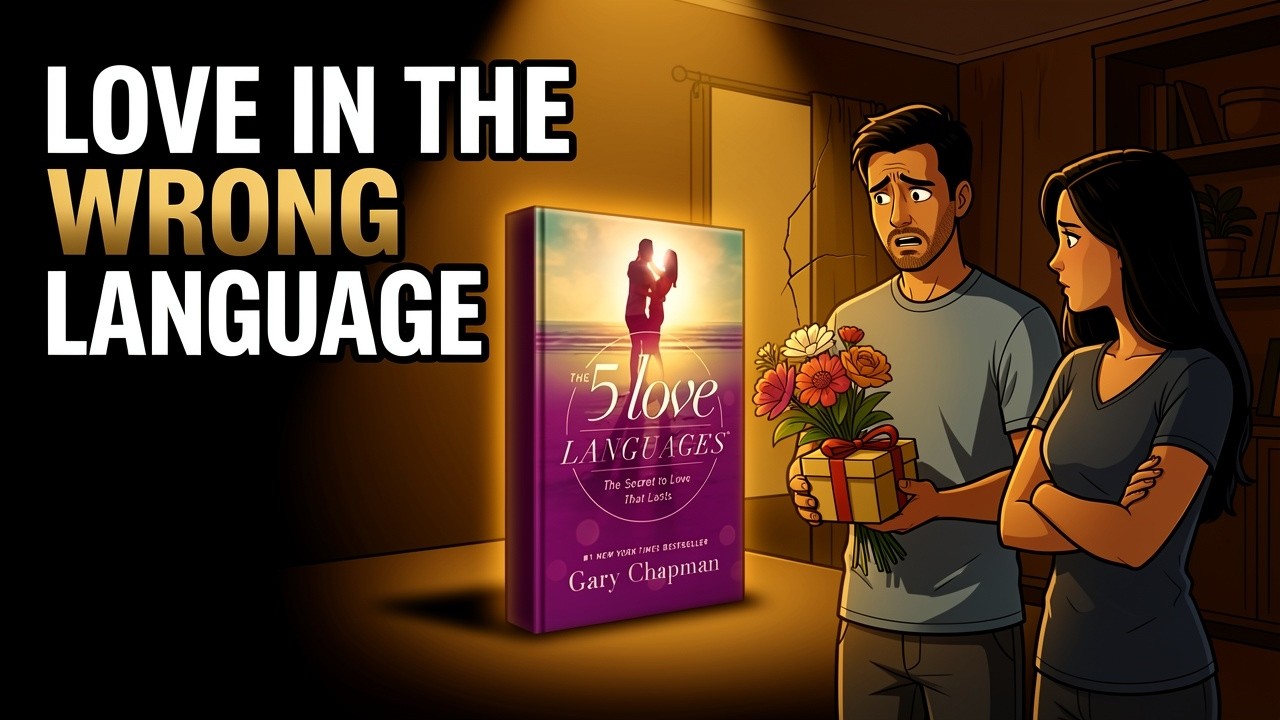
You come home after a long day. You cooked, cleaned and bought the groceries. You did everything you could think of to show you care. Then your partner says quietly, “You never tell me you love me anymore.”
You feel hurt. You spent three hours doing things for them. They feel hurt too, because they did not need chores. They needed to hear it. The 5 Love Languages says both people are trying to love, and both feel unloved. The problem is not the amount of love. It is the language.
What is The 5 Love Languages about?
Gary Chapman is an American marriage counsellor who published this book in 1992. It has sold millions of copies around the world.
During his years of counselling, Chapman heard the same complaints again and again. One was “He does not love me anymore”. Another was “I have tried everything”. He reviewed his notes and found that the complaints fell into five groups. He called them the five love languages.
The idea is not only for married couples. It also helps with parents, children, close friends and anyone you feel distant from.
Why you may speak the wrong language
Everyone has a main love language, the one that makes them feel most deeply loved. Think of two people who speak different tongues. You can say “I love you” in English all day, but if your partner only understands Hindi, the message does not land.
Chapman says we usually show love in the way we want to receive it. A person who values service cooks and fixes things. If their partner values words, none of that registers. Both are giving. Neither is receiving.
The five languages
Words of affirmation. Some people feel loved when they hear “I am proud of you” or “you look good today”. Tone matters. The same words said with sarcasm hurt. Chapman separates encouragement, which notices a real effort, from flattery, which is empty. A written note lasts, and praise in front of others counts twice.
Quality time. This means your full attention. Two people in one room are not together if one is on a screen. Good quality time includes calm conversation and listening to understand. When your partner shares a hard day, they often do not want a fix. They want you to say, “That sounds difficult. Tell me more.”
Receiving gifts. For these people, a gift is proof that you thought of them. It does not need to be costly. A favourite snack brought home, or a handwritten card, is enough. Chapman also describes the gift of presence: simply showing up in a hard moment.
Acts of service. Here, actions speak louder than words. Cooking, laundry or help with a project all show love. Chapman warns about a trap. During dating we help a lot to impress, then we stop when life settles. For this person, helping at home is saying “I love you” loudly.
Physical touch. A held hand, a hug at the door or a touch on the shoulder can matter most. Touch is strongest in a crisis. When someone is afraid or grieving, an embrace can say more than words. Not all touch is equal, so observe what your partner enjoys.
Falling in love does not last, and that is fine
Chapman says the intense in-love feeling rarely lasts more than about two years. In that time you overlook flaws and want every moment together.
When it fades, small habits start to irritate. Many people think the love is gone. Chapman says the love did not leave. What ended was the obsession that hid the real work. The shift from obsession to intention is where the real relationship starts.
The emotional love tank
Chapman uses the picture of a car’s fuel tank. When your partner speaks your language regularly, the tank is full and you feel secure. When it is empty, you feel lonely and resentful, even while sitting beside them.
Many couples have a full house and an empty tank. They provide for each other with money and care, yet leave each other short on emotional needs.
Why this also works outside marriage
Chapman wrote about couples, but the same idea fits other bonds. A teenager may feel unloved because her parents give money and food but never spend time with her. Chapman describes a girl like this who looked for love in the wrong places because her tank was empty. A colleague may feel unseen if praise never comes, even when pay is fair.
The lesson is to ask, not guess. A simple question such as “What makes you feel most appreciated?” gives you better information than your own habits can. Then you can give love in a form the other person can actually receive.
How to use this at work and at home
- Find your own language first. Ask what makes you feel most loved: words, time, gifts, help or touch.
- Watch your partner. Note what they ask for and what they complain about. A repeated complaint points to their language.
- Speak that language daily, in small ways. Give ten phone-free minutes each evening, leave a note, or hold their hand on a walk.
- Do not wait for the feeling. Treat love as a daily action, even on tired days.
- Use the idea beyond marriage. A parent can ask a child, and a manager can notice how a team member likes to be thanked.
Our take
The strongest part of the book is how simple and useful it is. It gives couples a gentle way to speak about needs without blame. The idea that your partner may need something different from what you need is easy to remember and easy to try.
There are limits. The five categories come from one counsellor’s experience, not from a large controlled study. Later research has not clearly shown that matching your partner’s language predicts a happier marriage. Real people often need several languages, and the labels can feel too neat. The book also does not replace help for deeper problems such as abuse or long conflict.
Treat the languages as a conversation starter, not a test with fixed answers. Used that way, they can help two people understand each other better.
The animated summary walks through all five languages with examples. It takes about 11 minutes.
Who should read The 5 Love Languages?
Couples, parents and anyone who gives a lot to a relationship and still hears 'I do not feel loved'.
Watch the full animated summary
Every idea from The 5 Love Languages, told as a story in about 11 minutes.
As an Amazon Associate, we earn from qualifying purchases.