The Four Agreements Summary: Free Yourself From Suffering
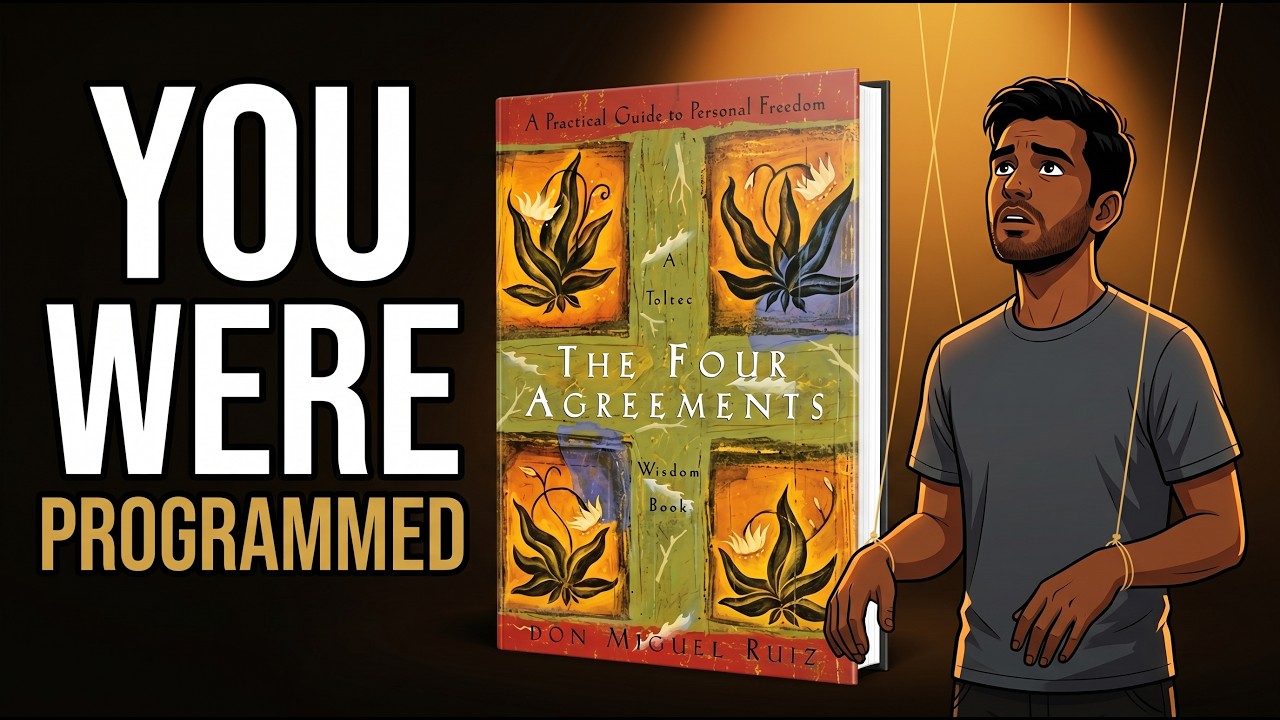
Prefer to watch? Open the animated summary on YouTube.
In one lineMuch of your pain comes from old rules you never chose, and four simple agreements with yourself can replace them.
Key lessons
- Many of your beliefs were taught to you as a child. They are agreements, and you can change them.
- Be impeccable with your word. Do not use it to gossip or to run yourself down.
- Do not take anything personally. What others do reflects their world, not your worth.
- Do not make assumptions. Ask questions and say clearly what you want.
- Always do your best, and know that your best changes from day to day.
- Change takes daily practice. Forgive yourself when you slip back.
- The aim is freedom from harsh self-judgment and from fear of other people's opinions.
On this page (9 sections)
- What is The Four Agreements about?
- You are living by rules you never chose
- Agreement one: be impeccable with your word
- Agreement two: do not take anything personally
- Agreement three: do not make assumptions
- Agreement four: always do your best
- Breaking old agreements takes practice
- How to use this at work and at home
- Our take
From the day you were born, you were being taught. Your parents, teachers and culture told you what to believe, how to behave and who you are. You did not choose most of it. You simply took it in, and it became the way you see yourself.
Some of those lessons help. Others hurt. The harsh voice that judges every move, the need for approval and the fear of getting it wrong all run quietly in the background. The Four Agreements by Don Miguel Ruiz says you can notice these old rules and replace them with four better ones.
What is The Four Agreements about?
Don Miguel Ruiz is a Mexican-American author. He published the book in 1997. He draws on Toltec wisdom, which is a set of ideas from an ancient Mexican tradition. He presents it as a practical code for peace and freedom, and does not ask you to join any group.
Ruiz uses the word “domestication” for what happens in childhood. We are trained with rewards and punishments until we judge ourselves in the same way. We then live inside a shared picture of how things must be.
His central claim is that you can break these old agreements. You do it by choosing four new ones. The book is short, and its power lies in how simple the four are.
You are living by rules you never chose
The first idea is the base for the rest. As children, we agree to beliefs without question, because we have no choice. These become the rules of our lives, even painful ones such as “I am not good enough” or “I must earn love by performing”.
Ruiz points out that these are agreements, not facts. You made them long ago and mostly without noticing. What you agreed to once, you can agree to differently now.
So the first step is awareness. When you hear harsh self-talk, ask whether it is a fact or a rule you learned.
Agreement one: be impeccable with your word
Ruiz calls this the most important agreement. Impeccable means without fault. Your word is the tool you use to shape how you and others feel. Use it with honesty and kindness.
It works in two directions. Outwardly, it means not gossiping, lying or spreading bad feeling. Inwardly, and more importantly, it means not using words against yourself. If you call yourself stupid every time you make a mistake, you are using your word to hurt.
A practical case: a team member misses a deadline and mutters, “I am useless.” Ruiz would ask her to say instead, “I missed this one, and I will plan better next time.”
Agreement two: do not take anything personally
Ruiz says that nothing others do is really about you. It is about their beliefs, their stress and their view of the world. An insult from a manager often says more about his day than about your worth.
When you take things personally, you become a victim of every mood around you. When you stop, you gain a kind of calm. This works for praise too. If you do not need insults to be false, you also do not need compliments to feel fine.
This does not mean you ignore feedback that is useful. It means you separate the message from the attack.
Agreement three: do not make assumptions
We often guess what others think, then believe our guess and react to it. Your friend does not reply to a message, and you decide she is angry. A senior colleague looks serious in a meeting, and you decide he dislikes your idea.
Ruiz says many conflicts start with such untested guesses. His answer is to ask. When something is unclear, check it. Say what you want in plain words. A short question can save days of worry.
Agreement four: always do your best
This agreement makes the other three work. You will not follow them perfectly, but you can do your best. Ruiz adds that your best is not fixed. It differs when you are rested and when you are ill or tired.
So do not demand the same peak every day. Give what you can in each moment. If you try to do more than your best, you risk burnout. If you do less, you may feel regret. Doing your best removes most of the blame you put on yourself.
Breaking old agreements takes practice
Ruiz is honest that this is not easy. Old agreements are deep, and the inner judge does not give up quietly. He sees much of our suffering as repeated self-punishment, where we judge ourselves again and again for the same mistake.
So treat this as a daily practice. When you catch an old pattern, choose the new agreement gently. Then forgive yourself for the slip. Over time the new habits get stronger and the old ones lose their hold.
How to use this at work and at home
- For one week, notice your self-talk. Write down three harsh phrases you use on yourself.
- Rewrite each one into a fair, kind sentence and use that instead.
- When someone is rude, say to yourself, “This is about their day.” Then decide if there is useful feedback in it.
- Before you act on a guess, ask one clear question. “Did my message come across as rude?”
- At the end of each day, ask, “Did I do my best today, given my energy?” If yes, let it go.
Our take
The strongest part of the book is its clarity. Four short rules are easy to remember and easy to test in daily life. The idea that we judge ourselves harder than others do is real for many people, and “do not make assumptions” can improve any workplace.
There are weak points. The book offers few studies or examples, and it reads more like a wise guide than a researched one. Its link to a specific ancient tradition is told as the author’s view and is hard to check. “Do not take anything personally” can also be taken too far. Some behaviour, such as bullying or abuse, is directed at you, and you should not simply accept it. In those cases, set a boundary or seek help.
Used with care, the four agreements are a gentle set of habits for a calmer mind.
The animated summary walks through each agreement with short stories. It takes about 15 minutes.
Who should read The Four Agreements?
Anyone with a harsh inner critic, who replays criticism for days, or who often feels hurt by what others say or do.
Watch the full animated summary
Every idea from The Four Agreements, told as a story in about 15 minutes.
As an Amazon Associate, we earn from qualifying purchases.