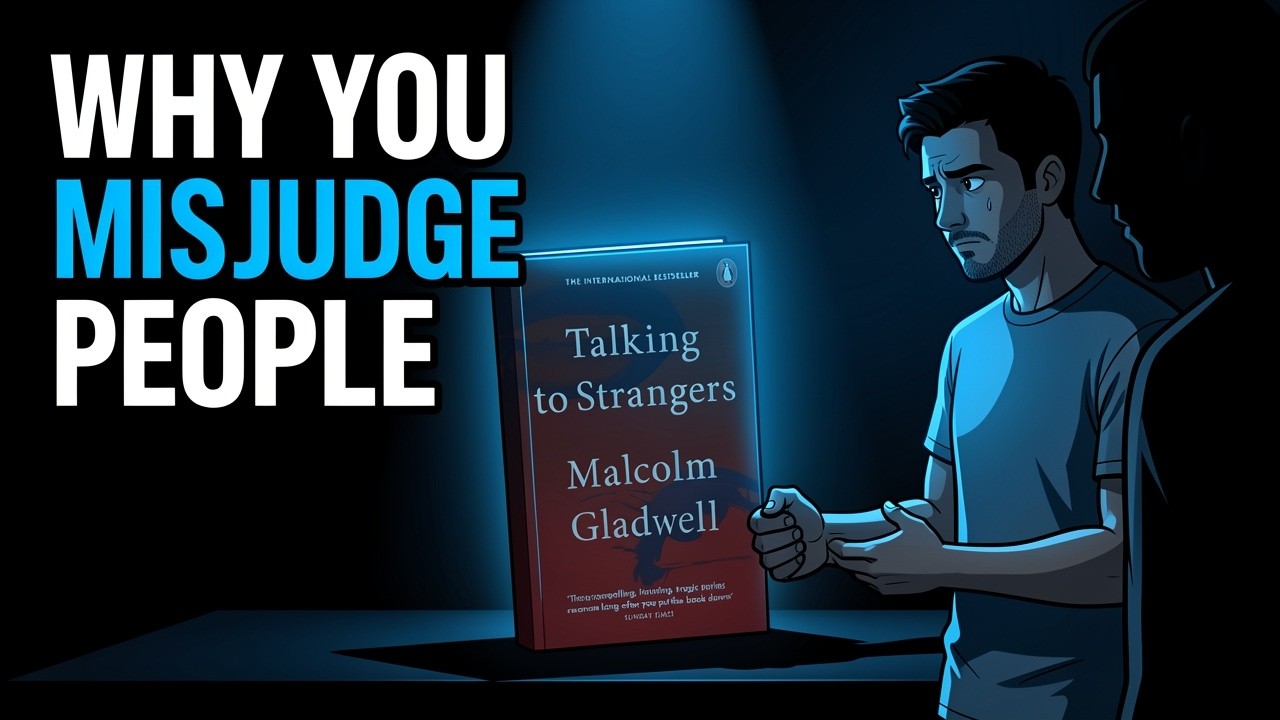
Talking to Strangers Summary: Why We Misjudge People
Prefer to watch? Open the animated summary on YouTube.
In one lineWe are poor at reading people we do not know, because we trust by default and feel sure of our read, so we should hold our judgments loosely.
Key lessons
- We believe strangers by default, and we only doubt them when the evidence is strong.
- Meeting someone in person can make you more confident without making you more accurate.
- We think we are hard to read and that other people are easy to read. Both ideas are wrong.
- Alcohol does not show the real person. It narrows attention to the moment in front of you.
- Behaviour is tied to its setting, so you cannot judge it without knowing the context.
- Even trained experts catch lies only slightly better than chance.
- Start with humility, look for context, and trust with care instead of cynicism.
On this page (9 sections)
You meet someone at a dinner. They are well dressed, calm and attentive. They ask good questions, so you open up about your work and your family. Weeks later you learn they lied to you from the start.
The painful question is not why they lied. It is why you did not see it. Talking to Strangers by Malcolm Gladwell says your instincts did not fail. They worked as designed, but they were built for a world of small groups where you knew everyone.
What is Talking to Strangers about?
Malcolm Gladwell is a staff writer at The New Yorker and the author of several bestselling books. He published Talking to Strangers in 2019.
The book asks a simple question: why are we so bad at understanding people we do not know? Gladwell uses real cases of spies, officials and ordinary people to show that our usual method for reading strangers is flawed.
This is not a book on networking tips. It is about the limits of human judgment, and the cost of those limits, from small embarrassment to serious harm.
We believe people by default
The key idea is called the truth default. The psychologist Tim Levine studied deception for decades. He found that we do not begin with suspicion. We begin with trust, and we only drop it when the evidence is overwhelming.
In many experiments, people spotted liars only about 54 percent of the time. That is close to a coin toss. The reason is not that we are foolish. If you doubted every claim, daily life would stop. Believing first is a useful shortcut that works most of the time.
Think of a recruiter in Bengaluru who hears a smooth answer in an interview. She accepts it, because that is how people work. The risk appears only on the rare day it fails.
Why meeting in person can mislead you
We think looking someone in the eye gives special insight. Gladwell argues that this feeling can be wrong. He tells the story of a British leader who met a foreign dictator several times in order to prevent a war. He studied the man closely and left convinced he wanted peace. He was badly mistaken.
The lesson is not that meetings are useless. A meeting creates a feeling of understanding, but the feeling can come from our own hopes. More face time raises confidence. It does not always raise accuracy.
We think we are hard to read
Gladwell calls the next idea the illusion of asymmetric insight. In a study, people looked at their own answers to a word exercise and said the answers showed nothing. They looked at a stranger’s answers to the same exercise and felt sure about that person’s character.
So we see ourselves as complex and others as simple. This makes us overconfident, and it makes us harsh. We blame our own slips on the situation. We blame other people’s slips on their character.
Alcohol and context
An old saying claims that wine shows the truth. Gladwell cites the myopia theory, which says the opposite. Alcohol narrows your field of view. Whatever is in front of you feels large, and long-term thoughts fade.
At a lively party, a drinker becomes bold and loud. Alone in a quiet room, the same drink can deepen worry. The drink is the same, but the setting decides the result. So a person who acts badly when drunk has not revealed a hidden self.
The wider point is that behaviour is tied to context. Gladwell notes that crime clusters in certain places and times, and that more patrols in those hotspots reduce it. A person who is calm at work may act differently at home. You cannot judge what someone did without knowing where they were and what pressure they faced.
Even experts get it wrong
Gladwell also shows that training helps less than we hope. He describes a senior intelligence analyst who was praised for years and was in fact spying for another country. A skilled officer questioned her and decided she was not a spy. He was wrong.
Police, judges and intelligence staff are not much better than ordinary people at catching lies. Extra information can even raise confidence without raising accuracy.
Judging people fairly
If we are so poor at reading strangers, what should we do? Gladwell does not tell us to stop trusting people. Trust is how society works, and a world of constant suspicion would be unbearable. His point is narrower. We should trust with open eyes and not take our confidence as proof.
Imagine a manager in Chennai who hires a candidate after one warm interview. The warmth feels like evidence. But the same candidate might have seemed cold on a bad day. The better step is to add checks that do not depend on first impressions, such as a work sample or a reference call.
How to use this at work and at home
- When you form an instant verdict about someone, pause. Your mind is filling gaps with assumptions, not facts.
- Ask about context before you conclude. What pressure are they under, and what is their setting?
- In hiring or deals, rely on checks and records, not on your feeling after a good meeting.
- Extend good faith, but know your judgment may be wrong. Trust with care, not with certainty.
- Judge others by the same standard you use for yourself. Ask what you would say if the slip were yours.
Our take
The strongest part of the book is its humility. It does not promise a trick for spotting liars. It shows why such tricks rarely work, and that is useful for anyone who hires or negotiates.
The weak points are also clear. Gladwell builds his case from vivid stories, and stories can make a pattern look stronger than the data allows. Some chapters cover sensitive real events, and readers may feel his conclusions are too neat. The advice at the end is also thin. Knowing that you misjudge people does not tell you exactly what to do on Monday.
Still, the main habit is worth keeping. Hold your first read loosely and leave room to be wrong.
The animated summary explains each idea with examples. It takes about 11 minutes.
Who should read Talking to Strangers?
Anyone who hires, negotiates, manages or meets new people, and anyone who has been surprised by someone they thought they understood.
Watch the full animated summary
Every idea from Talking to Strangers, told as a story in about 11 minutes.
As an Amazon Associate, we earn from qualifying purchases.