Superagency Summary: Will AI Take Your Job? The Good News
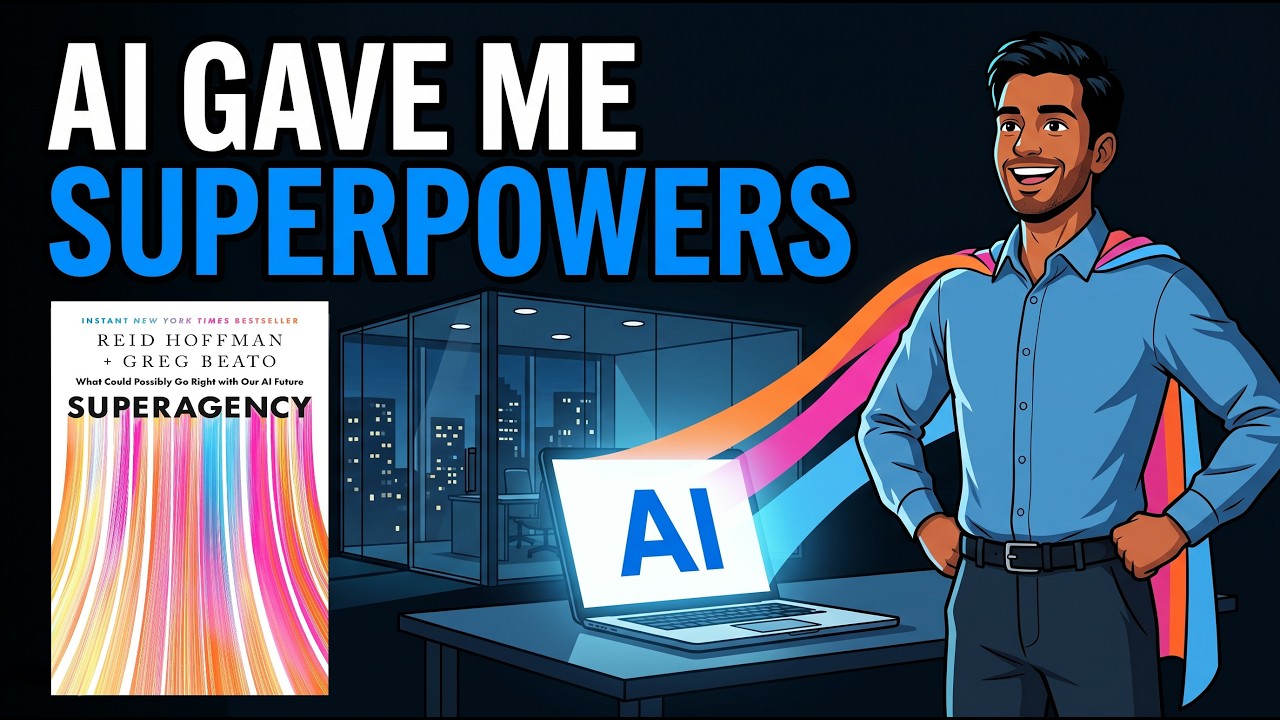
Prefer to watch? Open the animated summary on YouTube.
In one lineBanning AI will not protect your job; the people who use it and keep learning gain the most power to choose their own path.
Key lessons
- The fear that machines will leave people jobless is old, and it was wrong in 1961.
- The real question is not whether AI takes your job, but whether you keep control of your work and your livelihood.
- Banning or freezing new technology keeps yesterday's jobs and loses tomorrow's.
- In the studies the book cites, beginners gained more from AI than experts.
- Use AI, check it, correct course, and share what works.
- Do not judge a tool by one failure; fix the failure and keep going.
On this page (7 sections)
A colleague who uses AI every day seems to have a superpower. Meanwhile a layoff headline sits on your phone, and your own job feels a little smaller each week. It is natural to ask if AI will take it. Superagency does not promise that your job is safe. It argues something more useful: the people who use AI well will gain the most, and you can be one of them.
What is Superagency about?
Superagency was published in 2025. It is written by Reid Hoffman and Greg Beato. Hoffman co-founded LinkedIn and was an early backer of OpenAI, so he is no outsider to the technology.
The word “agency” means your power to choose your own path. The authors’ idea is that when many people gain agency from AI, the benefits spread to everyone around them. That includes people who rarely use it. They call this “superagency”.
The book takes the fear seriously. It admits that AI may compete with almost all of us in some way. Then it makes the case that the best response is to learn the tool, not to fight it.
Why the fear of machines is not new
In 1961, Time magazine reported a warning from labour experts. Automation, they said, would keep adding to the ranks of the permanently unemployed. They had real evidence, because bakers, meat cutters and car workers were all shrinking in number.
Yet the permanent mass unemployment never came. The experts saw something real, since some jobs did shrink. What they missed was everything the same machines made possible.
The book goes back further. Socrates worried that writing would harm living thought, because a written page cannot answer a question. Today, books are how ideas travel beyond the people who had them. The authors use these stories to say that fear of a new tool often misses where the tool leads.
Why banning AI protects nobody
Many people hope someone will press pause. In March 2023, an open letter asked AI labs to stop training stronger systems for at least six months. More than 33,000 people signed it. The work did not stop, and the tools kept improving.
The authors also tell the story of the Luddites. In England in 1811, weavers who lost work to factories began smashing machines. Then the authors imagine something and say clearly that it is invented. Suppose Parliament had passed a law in 1820 banning any new machine until its effects on jobs were settled. Life would feel familiar. Cloth would cost more. Eighty years later, other countries would have jobs nobody in 1820 could picture, and England would have scratchy, pricey blankets.
It is a thought experiment, and the authors admit it simplifies history. But the point is clear: you cannot reach the future you want by banning the future you fear.
Safety first, or use first?
A fair objection is that anything new should be proven safe first. The book answers with cars. Early cars were deadly. Yet people chose them because a car multiplied what one person could do, and the problems were solved by more invention. The authors say the death rate per mile driven in America has fallen by 93 percent since 1923.
Their view is that real use shows everyone what needs fixing. They also sort people into four camps: Doomers, Gloomers, Zoomers and Bloomers. The authors call themselves Bloomers. They are optimists who want many people using AI in daily life, with both freedom to build and a duty to regulate.
Who gains most from AI at work?
This is the part that matters most to your career. The book cites a study of 444 marketers, grant writers and analysts. Those who used ChatGPT finished writing tasks 37 percent faster. The biggest quality gains went to people whose first draft had scored lowest.
A second study followed customer service agents. Their productivity rose 14 percent, and the largest gains went to less experienced agents.
So experience alone is not a shield. Think of a marketing manager in Pune with seven years of good work. A first-year colleague opens the AI tool every morning. The senior person keeps it closed to protect his craft. Within months the gap in speed is plain, and it is not a gap in talent. It is hours of practice.
The authors compare AI to GPS. A map helps a local now and then. For a visitor in a new city it changes everything. The same map gives the most to the newcomer.
How to use this at work and at home
- Open an AI tool this week on the part of your job you find hardest. Do not judge it by one weak answer.
- Give clear instructions and context. A vague request gives a bland result, which proves little.
- Check the output before you share it. If it will be seen by clients or in another language, ask a person who knows the language to review it.
- Use it at home too. Photograph a confusing letter or form and ask the tool to explain it in plain words.
- Share what works. Show your team one thing the tool did well and one thing it got wrong each week.
Our take
The strongest part of Superagency is its patience with fear. It does not call worried people foolish. It admits that nobody knows how good AI will get, and that losing a livelihood is a real shock. The historical stories, especially the 1961 panic, give useful calm.
The weaker part is that the optimism comes from an author deeply tied to the industry. The imagined 1820 law is memorable, but it is a simplified story, and the authors say so. The book gives less attention to people whose jobs are shrinking right now and who cannot easily retrain. Workers in routine roles may find the case for “just learn the tool” too easy.
Still, the practical message holds up. Avoiding AI is not a plan, and learning it with care is. If you want a more hands-on guide to working beside AI, pair this book with Co-Intelligence.
The animated summary tells these stories in order, with one marketing executive who learns the lesson the hard way. It takes about 20 minutes.
Who should read Superagency?
Professionals who feel nervous about AI at work and want a calm, evidence-based case for learning it instead of avoiding it.
Watch the full animated summary
Every idea from Superagency, told as a story in about 20 minutes.
As an Amazon Associate, we earn from qualifying purchases.