
Stolen Focus Summary: Why You Cannot Focus and How to Fix It
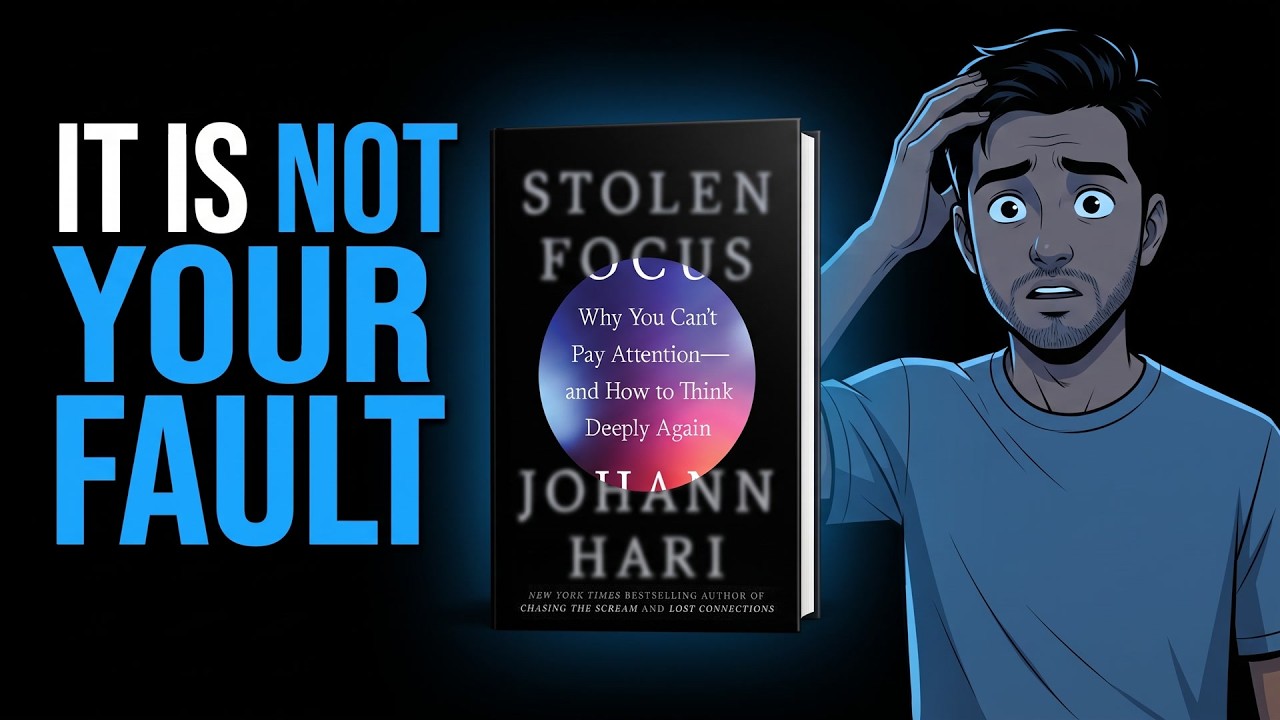
Prefer to watch? Open the animated summary on YouTube.
In one lineJohann Hari argues that your focus is being taken by technology and modern life, not lost through weakness, and you can win much of it back.
Key lessons
- Poor focus is not only a personal failing. Phones and apps are built to hold your attention.
- Flow is the deep focus where your best work happens, and constant interruption destroys it.
- Multitasking is really fast switching, and every switch costs time, accuracy and depth.
- Anger keeps you on a screen longer, so many feeds push content that upsets you.
- Sleep, food, movement and slower living all shape how well you can concentrate.
- Reading a real book for ten minutes a day can rebuild your ability to stay with one thing.
- Willpower alone loses. Change your surroundings so that focus becomes the easy choice.
On this page (9 sections)
You sit down to finish an important task. Within a minute your hand is on the phone. You tell yourself you are weak, lazy or just not disciplined enough. Then you try again tomorrow and the same thing happens.
Stolen Focus by Johann Hari asks you to stop blaming yourself. His claim is that your attention is not simply lost. It is being taken, by products and habits of modern life that profit when you cannot look away. If that is true, then more willpower is the wrong fix.
What is Stolen Focus about?
Johann Hari is a journalist who published Stolen Focus in 2022. The book looks at why so many people find it hard to concentrate, read or think deeply. Hari does not treat this as a personal problem. He treats it as a social one.
The book looks at many causes. They include technology built to grab attention, constant switching between tasks, the speed of life, poor sleep and poor food, and the decline of deep reading. This summary follows the main ideas from the video.
This matters because most of your work, and much of your family time, depends on your ability to pay attention.
Your attention is taken, not lost
Hari starts with a famous idea from psychology. The psychologist B. F. Skinner showed that you can train behaviour with rewards. Give a pigeon a food pellet and it will peck a button again and again.
Hari says modern apps use the same idea. Every like, every notification and every red dot works like a pellet. Skilled engineers design them to keep you checking.
Think of your own evening. You sit down to read or to start something that matters. A few minutes later your hand reaches for the phone, and you do not remember deciding it. You are one person against a large team whose job is to beat your self-control. That is not a fair fight.
What you lose is flow
The thing being taken has a name: flow. It is the state where you are so involved in one task that time seems to vanish. The researcher Mihaly Csikszentmihalyi studied it for years. He found it needs three things. You do one thing at a time. The task matters to you for its own sake. And it is hard enough to hold you, but not so hard that you give up.
Now look at a normal workday. You are rarely doing only one thing. Much of what you do feels like it belongs to someone else. And you relax by scrolling, which gives you no flow at all.
Getting flow back is not mysterious. Pick one task. Close every other tab and window. Put the phone in another room. The first ten minutes feel uncomfortable, like withdrawal. After that, many people find their mind works better than it has in months.
Multitasking is a myth
Many people believe they can do several things at once. Hari says the brain cannot. It can hold only one, or at most two, thoughts at a time. What feels like multitasking is fast switching, and each switch has a cost. It takes time to reload the new task. You miss details. And you never stay long enough to think deeply.
Picture a manager who answers email in a meeting while a colleague speaks and a chat window blinks. He feels busy and useful. In truth he heard the colleague badly, replied to the email carelessly and missed the point of the meeting. His colleague who closed her laptop and listened did one thing well. Doing one thing at a time only feels slower, because it asks you to face the task fully.
Anger keeps you scrolling
Hari also argues that the technology in your pocket studies you. Every tap and pause becomes data about what holds your attention. He calls the business of selling that attention surveillance capitalism.
He says people stare longest at what angers or threatens them. So feeds learn to show you more of it. This harms your thinking. When you are angry, you stop asking whether an idea is true or wise. You only react.
You have probably lost an hour to an argument with a stranger about a headline that may not even be true. Hari’s point is that this hour was shaped for you, because your anger is worth money to someone else.
Speed, sleep and food shape your focus
The problem is not only phones. Hari says life has simply become faster. More information arrives every day, but the human brain has not changed to match. So we skim. We take a thin taste of everything and a deep drink of nothing. The answer, he says, is to slow down on purpose. Long walks, unhurried reading and even yoga help you rebuild concentration.
Your body matters too. Attention is a physical act. Hari points out that people sleep less than they did a century ago, and a tired brain cannot hold focus. He also describes how sugar and heavily processed food can send your energy up and down. The three o’clock slump, when you read the same line four times, is often last night’s short sleep meeting lunch.
Reading is a muscle
Hari calls deep reading a muscle that many of us are letting weaken. He notes that more than half of adults do not finish a single book in a year. Reading on a screen trains us to skim. A book asks the opposite. It asks you to follow one voice, for a long time.
The hopeful part is that you can rebuild this. Read a real book for ten minutes a day, with the phone in another room. At first your mind will fight to escape. Stay with it. Over weeks, the ability grows back.
How to use this at work and at home
- Do your most important work in one block. Close every other window and put the phone in another room, not just face down on the desk.
- Treat sleep like a meeting you cannot cancel. Set a fixed time to go to bed.
- Read a real book for ten minutes each evening, a few pages at a time.
- Take a slow walk without headphones, at least a few times a week.
- If you have children, protect their sleep, outdoor play and bored time. Do not use a screen to keep them quiet.
Our take
The best thing about this book is the reframe. Many people carry shame about their focus, and Hari removes it. That alone helps, because shame is a poor teacher. The ideas on flow, task switching and sleep are practical and easy to test in your own week.
The book has limits. Hari shows that the problem is shared, but most of his solutions are still personal. He admits a digital detox gave him only short relief. He is right that lasting change needs the products themselves to be built differently, yet a reader cannot make that happen alone. The evidence is also stronger for some causes than for others, so it is wise to read the claims about food and additives as pointers, not proof. And not everyone can leave a phone in another room. If you are on call for work or for family, you will need a plan that fits.
Even so, the core advice holds up. Stop asking for more willpower from a tired mind. Change what is around you, and focus becomes easier.
The animated summary walks through each idea with stories. It takes about 17 minutes.
Who should read Stolen Focus?
Professionals and parents who feel scattered, reach for the phone without thinking, and blame themselves for it.
Watch the full animated summary
Every idea from Stolen Focus, told as a story in about 17 minutes.
As an Amazon Associate, we earn from qualifying purchases.


