
Power Summary: Why Hard Work Alone Does Not Get You Promoted
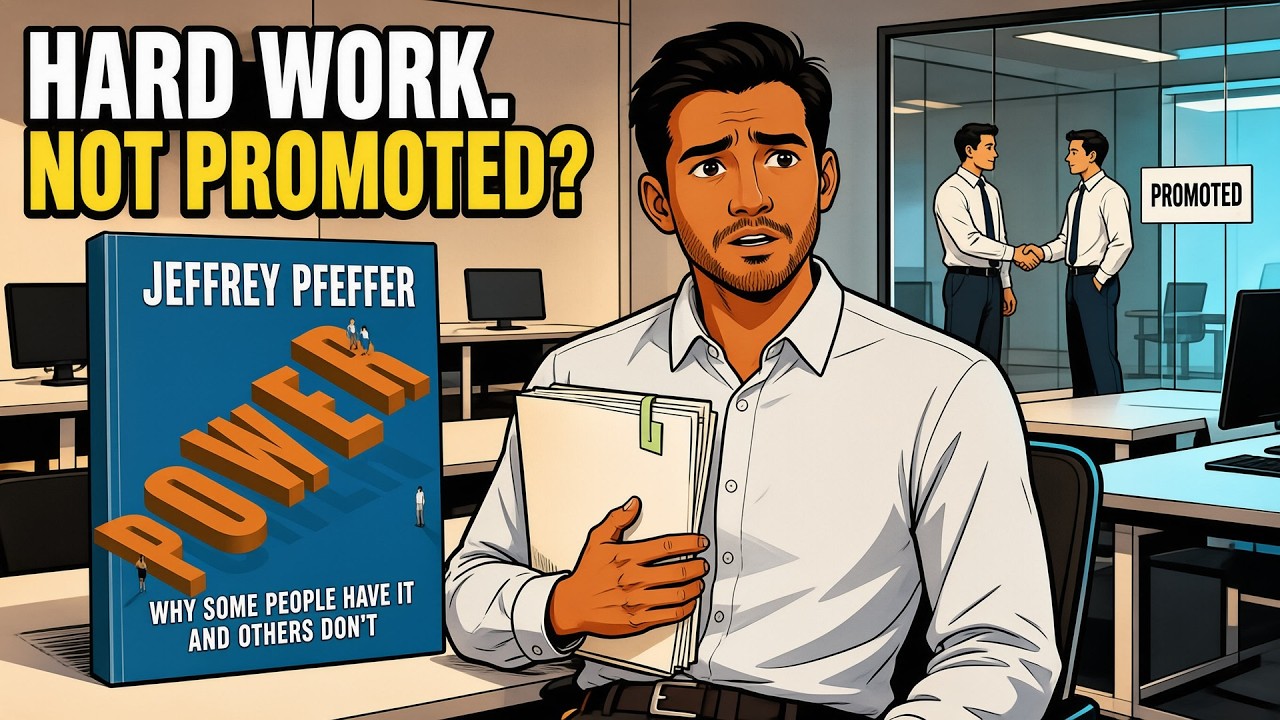
Prefer to watch? Open the animated summary on YouTube.
In one lineGood work gets you into the race, but the people who decide pick those they can see and want near them.
Key lessons
- Great performance can trap you in your current role if no one above your boss knows you.
- Your boss judges you on their priorities, not on your list. Ask what matters to them.
- Quiet, heads-down work rarely gets noticed, and what is not remembered is not chosen.
- Asking for advice or help works better than most people expect, and it flatters the person asked.
- A small job nobody wants can put you in the room with senior people.
- Build a wide network before you need it, and join the team where power is going.
- Handle conflict fairly: leave people a graceful way to back down.
On this page (9 sections)
You do excellent work. You fix problems at night, meet every deadline and never complain. At appraisal time, the rating says “meets expectations”, and a louder colleague gets the promotion. You tell yourself it is all office politics.
Jeffrey Pfeffer would say the word hides something useful. In Power, he argues that good work is only your ticket into the race. What decides who wins is who can see you, and who wants you close.
What is Power about?
Jeffrey Pfeffer is a professor at Stanford Graduate School of Business. He published Power: Why Some People Have It and Others Don’t in 2010. The book is not a guide to dirty tricks. It is a study of what actually decides who gets promoted, picked and protected.
Pfeffer’s main claim is that people prefer to believe in a fair world. That belief is comfortable, but it can keep you from building the support you need. The book asks you to deal with the workplace as it is, not as it should be.
Why great work can trap you
Pfeffer describes a young executive named Phil. Phil delivered complex technology projects on time and under budget. His boss rated him highly. When Phil asked to move to another part of the business, his boss said no. Phil was too good in the job he already held.
The boss never brought Phil to the attention of anyone else. Phil had made himself too useful to move. Pfeffer also tells of a factory manager, Glenda, who turned around troubled plants for ten years. Her reviews and bonuses were excellent. Her bosses still saw her as brilliant where she was, not as senior executive material.
You may know this from your own office. A reliable engineer keeps a client system running for years. Everyone depends on the person, and no one wants to move them.
Performance is not the whole story
The book cites research for this. In one study of 354 office workers, supervisors gave higher ratings to people they had helped to hire. This held even after the researchers allowed for how well the person did the job. In plain words, your rating depends partly on how much your boss has invested in you.
Another study at an aircraft maker found that workers rated very good were only 12 percent more likely to be promoted than those rated good. We worry about the higher rating, yet it barely changed the odds.
Pfeffer does not say performance is useless. He says performance plus political skill is what helps people rise. Quiet work, however good, usually goes unnoticed.
Find out what your boss really values
Pfeffer tells of Melinda, a manager at a credit card company. She wanted an important qualification, and the senior executive who would approve it liked her. One day she told him that a staff member’s bad behaviour reflected on his own leadership. She may have been right. It cost her anyway, because leadership was where he felt weakest.
The lesson is narrow but helpful. Raise problems without attacking your boss’s picture of himself. And ask the people in power which parts of your job matter most. You judge yourself on your list. They judge you on theirs.
A long email listing everything you fixed this year rarely helps. A short answer to “What matters most to you this quarter?” does more. If the answer is “the audit”, then describe your work as audit risks closed.
Ask, and take the small jobs
Most people think asking looks weak. Pfeffer describes a study in which people guessed they would need to ask about twenty strangers to get five yeses. They needed about ten. We think asking is a burden, so we ask too little. Asking for advice also flatters the other person.
He also stresses small, useful jobs. Michael was a business student hired by an investment firm. The summer team had six people, and five would stay on. Michael had to go back to school. So he volunteered to organise the firm’s hiring day, a job nobody wanted. That put him at the centre of every recruiting message and in touch with senior partners.
The job has to be real. It is not showing off if the work helps the business. Think of an event, a client report or a training day that your team avoids.
Build a network before you need it
Pfeffer writes that networking takes thought more than time. Know people across several circles, even loosely. And sit where the information flows. In the book, one analyst took a desk outside a senior partner’s office, almost by chance. Soon most questions in the Monday meeting were pointed toward that desk.
He also advises you to join the team where power is going, not only where it is today. A team’s current power shows in its pay, its closeness to the top and its seats on key committees. To see where power is going, ask which team is solving the company’s next big problem.
Why one supporter is not enough
Pfeffer tells of Ray, an HR executive who built a well-rated leadership programme with the chief executive’s approval. When that executive retired, Ray faced a layoff of exactly one person: himself. He had one supporter and no network.
Gary Loveman, in contrast, became chief operating officer at a casino company. An older finance chief resented him, and the job was critical. Loveman visited him almost every day and involved him in decisions. At some point, Loveman said, you simply have to make key relationships work.
How to use this at work and at home
- Ask your manager one question this week: “What matters most to you this quarter?” Reframe your work in their words.
- Count how many people two levels above your boss know what you did this month.
- Volunteer for one visible, useful job that others avoid.
- Take a colleague from another team to lunch each month. Build links before you need them.
- Pick your next team by asking where the company’s next big problem is being solved.
Our take
The strongest part of Power is its honesty. Many professionals believe that results speak for themselves. Pfeffer shows with research and stories that they often do not. His advice on asking, small jobs and networks is practical and fair, and nothing in this page needs lying or backstabbing.
The book has weak points. Some stories come from interviews and memory, so they may not apply everywhere. Pfeffer also describes harsher tactics that readers may not want to use. A culture that rewards visibility can be unfair to people who are shy or who work remotely. In some companies, results truly do matter more.
Even so, the core message is useful. Your work needs an audience. If you wait to be noticed, you may wait a long time.
The animated summary follows one engineer through these ideas. It takes about 20 minutes.
Who should read Power: Why Some People Have It and Others Don't?
Hard-working professionals who do excellent work, wait to be noticed, and feel overlooked at appraisal time.
Watch the full animated summary
Every idea from Power: Why Some People Have It and Others Don't, told as a story in about 20 minutes.
As an Amazon Associate, we earn from qualifying purchases.