Extreme Ownership Summary: How Navy SEAL Leaders Take Charge
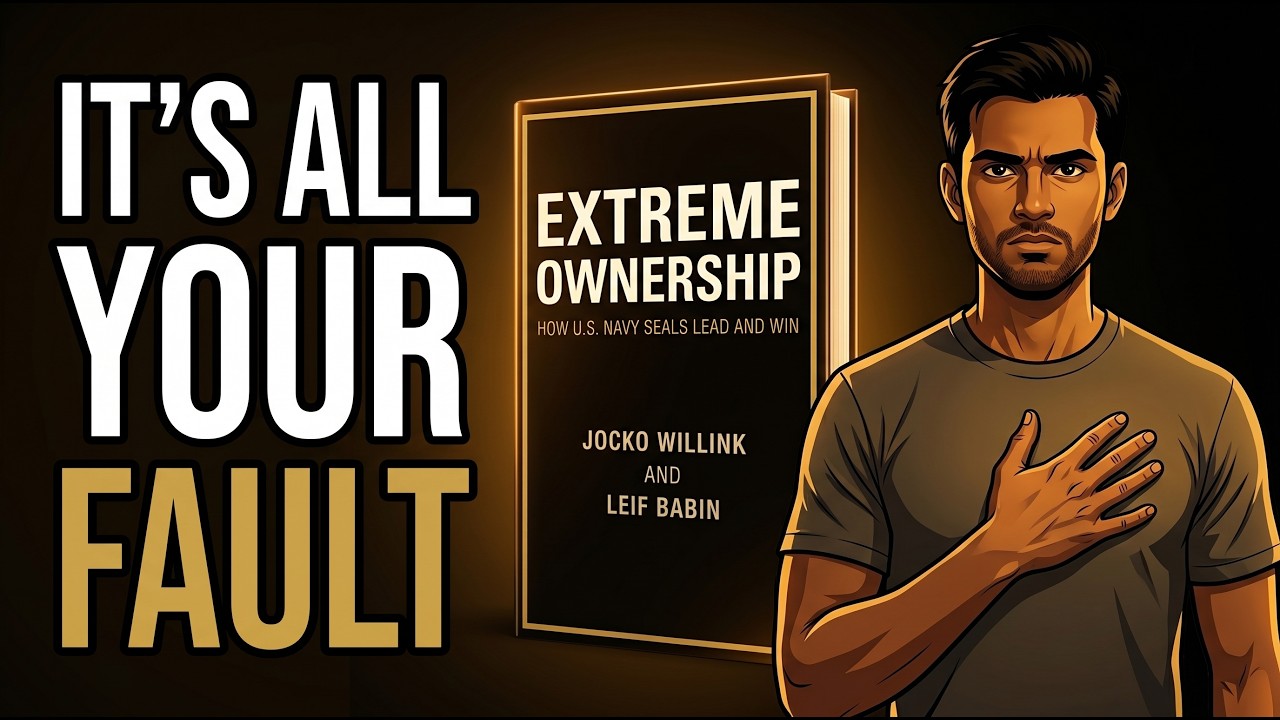
Prefer to watch? Open the animated summary on YouTube.
In one lineA leader owns every result on the team, including failures, because what you own is what you have the power to fix.
Key lessons
- Take full responsibility for every outcome on your team, with no excuses.
- There are no bad teams, only bad leadership. If results are poor, look at how you lead first.
- Check your ego. Admit mistakes, hear hard feedback and put the mission above being right.
- Believe in the mission and explain the why, so people commit instead of just comply.
- Cover and move: teams must support each other and not work in silos.
- Keep plans simple. In chaos, pick the top priority and solve one problem at a time.
- Let your people lead at their level, and build discipline, because discipline creates freedom.
On this page (8 sections)
A project misses its deadline. In the review meeting, everyone has a reason. The client changed the scope. Another team was late. The instructions were not clear. All of it may be true, and nothing improves.
Extreme Ownership says the best leaders do the opposite. When something fails, they look at themselves first. They take full responsibility, even for things they did not do directly. The authors say this habit is not a burden. It is where a leader’s power comes from.
What is Extreme Ownership about?
Jocko Willink and Leif Babin are former US Navy SEAL officers. They led a SEAL task unit in the Iraq War, in the city of Ramadi, and later started a leadership training company. They published Extreme Ownership in 2015.
The authors wrote the book from lessons learned in combat, where mistakes cost lives. They found that the same rules work in offices, factories and families. Their main idea is in the title. A leader must own everything in their world. If everything is your responsibility, then everything is also within your power to improve.
This matters now because many workplaces are full of blame, silos and unclear goals. These ideas are a direct answer to that.
Why ownership gives you power
Most of us protect our ego when things go wrong. We explain why it was not our fault. That feels good, but it makes you powerless, because you are now waiting for others to change.
Ownership works the other way. If a team member underperforms, ask yourself some questions. Did I train them well? Did I explain the goal clearly? Did I check in often enough? These questions point to things you can fix today.
Take a sales manager in Pune whose team keeps missing targets. Instead of calling the team lazy, she checks her own work. She finds she never explained how the targets were set. She fixes that first.
There are no bad teams, only bad leaders
The authors tell a story from SEAL training. A weak boat crew and a strong boat crew swapped leaders. The weak crew then began to win, and the strong crew fell behind. The authors conclude that the leader set the standard in both cases.
This is a hard idea. It says you cannot blame your team for poor results. But it is also hopeful. You may not be able to change your people, but you can change how you lead them.
Look at three things. Are the standards clear and high? Does everyone know the mission? Is everyone held to account in the same way?
Check your ego, believe, and explain the why
The authors call ego the biggest obstacle. Ego stops you from admitting mistakes, hearing feedback or putting the mission before your pride. A leader with a big ego defends their image and does not solve the problem.
Good leaders are confident but humble. They are willing to say, “I was wrong,” and to learn from people below them.
The authors also say people cannot commit to a mission they do not believe in. So the leader must first believe in it, and then explain the why. A task with no reason attached gets weak effort. A task tied to a clear purpose gets full commitment.
Cover and move, and keep it simple
“Cover and move” is a combat term. One team protects the other while it moves, and then they swap. In a company, it means departments support each other. The danger is a place where sales blames operations, operations blames finance, and everyone forgets the shared goal.
The authors also push for simple plans. If your team does not understand the plan, that is your job to fix. When many problems hit at once, do not try to solve all of them. Step back, find the one top priority, solve it, and move to the next. They describe a simple routine: relax, look around, and make a call.
Decentralised command and discipline
No leader can manage every detail. The authors teach “decentralised command”. You give your people the mission and the reason behind it, then trust them to make decisions at their level. You do not micromanage.
Their last idea sounds like a paradox: discipline equals freedom. Keeping routines and standards takes effort. But over time it gives you more skill, more trust and more room to act.
How to use this at work and at home
- Next time something goes wrong, write down what you could have done differently before you write down what others did.
- Check your standards. Tell your team in one sentence what good work looks like.
- Explain the why behind each major task. If you cannot explain it, find out first.
- Cut each plan down until a new joiner could repeat it back in two minutes.
- Give one capable person a decision you normally make yourself, and tell them the goal, not the method.
Our take
The strongest part of this book is its clear and honest message. Starting with your own role is a useful habit for any manager. The examples are vivid, and the tools, such as “prioritise and execute”, are easy to remember.
There are limits. The stories come from a military setting, where orders are followed and the chain of command is clear. An office with unclear roles, weak budgets or a difficult boss is a different place. Total ownership can also be unfair if you carry blame for things you truly cannot control. And the book tells you less about how to handle a leader above you who refuses to own anything.
Treat the book as a mindset, not a rulebook. Use ownership to focus on what you can change, and be fair to yourself about what you cannot.
The animated summary walks through each idea with stories. It takes about 12 minutes.
Who should read Extreme Ownership?
New and experienced managers, team leads and business owners who want better results without blaming people or circumstances.
Watch the full animated summary
Every idea from Extreme Ownership, told as a story in about 12 minutes.
As an Amazon Associate, we earn from qualifying purchases.